• Invisible green belts in Beijing: From romantic landscape to businesses opportunity


    The green belt may be a British idea imported to China, but the concept has worked out to be very different in practice. In the context of Beijing’s urbanisation, it turns out that the local state uses the ecological discourse of the green belt to legitimate its land businesses. Despite the differences, we suggest that there are lessons from China for Britain. In 1958, Beijing saw the approval of its first modern master plan (Beijing-Archives 1958). The municipal government of Beijing proposed in this master plan that “the layout of urban construction should not be concentrated in the city centre anymore, and that a new style is needed with green spaces planned between decentralised conglomerates” (ibid). This marks the birth of Beijing’s green belt as an idea (or, maybe more accurately, a feature on a map).

    The idea of Green Belt in Beijing also corresponded to the heydey of a socialist campaign named “The Great Leap Forward” during which the Chinese people were mobilised by Mao Zedong to “surpass Great Britain and catch up with the United States.” Among many targets of this ambitious campaign, “gardening the Earth” was set as a socio-ecological goal to achieve (Chen 1996). In this moment, Sir Ebenezer Howard’s modernist imagination of urban space and Mao Zedong’s socialist modernist vision of the country encountered and blended with each other. Through this encountering, the British-born planning canon was embedded in Beijing’s urban planning practices, which in turn produced a view of landscape including the green belt that mixed the revolutionary and the romantic.

    For Chen Gan, then director of Master Plan Office in Beijing Urban Planning and Administration Bureau, a decentralised city layout including green belts could be a flexible tool to deal with rapid urbanisation and could direct urban development in a well-planned way in the long future (Chen 1996, 13-17; originally written in 1959). This partly explains why green belt has been set as an essential part of the urban area in Beijing since 1958. In practice, however, Beijing’s green belt existed more as a part of the master plan than real space for nearly four decades. In a letter written by Chen Gan in 1967, he admitted that suburban vegetable plots (more than 153.33 km2) had covered a majority of the planned green belt area. Beijing’s green belt had not achieved a romantic landscape of open countryside but was full of rural communities, residents, and their cultivated fields.

    In 1994, the Beijing municipal government (BMG) focused once again on the green belt. Their new aim, familiar to the UK, was to prevent the sprawl of urban areas and to make the 240km2 green belt “really green” (BMG 1994). The BMG gave the market and capital a key role as villages located within the green belt were required to “use green spaces to attract investments, and utilise these for the exploitation of land, build green spaces in the exploitation process, and cultivate green spaces through green industry” (ibid; my italics). These policies can be summarised in a simpler way: the green belt was to make acceptable the promotion of real-estate development in the urban fringe.

    17 townships and villages were included in the city’s green belt, they covered 95.23 km2 in total (39.7% of the planned green belt as a whole). In the following three years, however, only 8.62 km2 of this land was ‘turned into green’, while another 11.16 km2were expropriated by BMG for land businesses and infrastructure construction (Beijing Municipal Committee of Urban Planning, 1999). On the other hand, the area of farmland and vegetable plots in this area decreased significantly between 1993 and 1999 (down from 130 km2 to 61.82 km2), and a majority of this decline can be explained by the development of real estate projects (ibid). In this same process, 1.33 million square metres of residential houses were built and sold. The green belt was not “really green,” but became a part of the city’s urbanisation process and turned out to be a “really expensive” area to live in.

    These outcomes made clear to municipal officials the potential values of land plots in the planned green belt area. From 2000 to 2003, another set of policies were proposed by BMG to enhance its ‘land businesses’. The “General Headquarter for Building Beijing’s green belt” was established in 2000, headed by then-Mayor Mr Liu Qi (BMG 2000). In 2002, the “General Headquarter” commanded that “related townships and villages are strictly forbidden to attract any investments for land development in the Green Belt” (BMG 2002). “All construction land plots,” they said, “that have not been used in the Green Belt area should principally be expropriated by BMG before any kinds of land transactions” (ibid). BMG’s ambition of controlling more land resources was further practised by proposing the second green belt in 2003 (with a total area of 1,620 km2, see the dark green area in Figure 1) and establishing a “land reservation mechanism” (tudi chubei) in the same year (BMG 2003). These policies together enabled BMG to gradually achieve and practice a monopoly of land supply at the city level (Beijing Municipal Bureau of Land Resources, 2011).
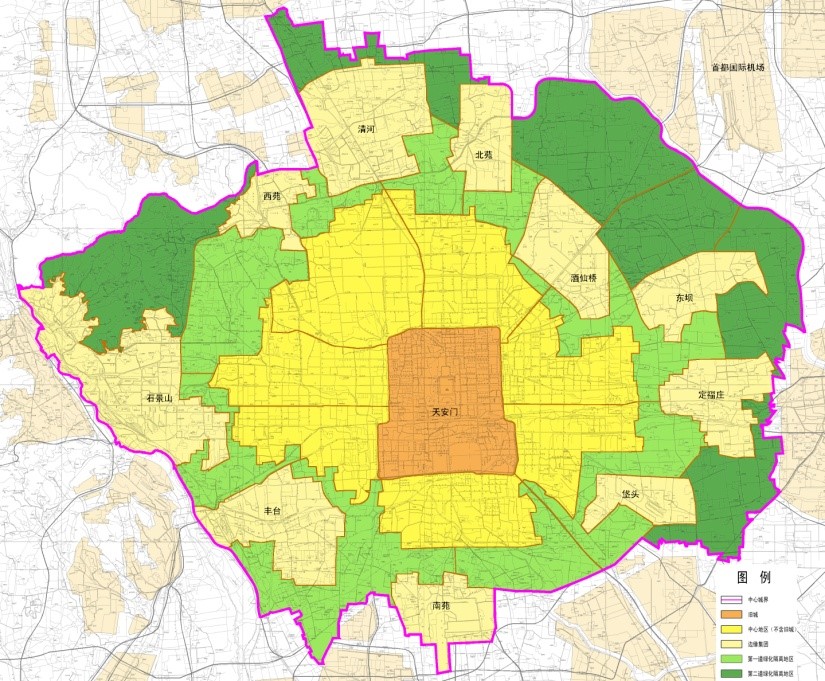
    Beijing green belts

    Figure 1: A bird’s eye view of Beijing’s two green belts,  Source: BMCUP (2013). Note: (1) the purple line denotes the boundary of the city’s “core urban area”; (2) the light green area signifies the first green belt, proposed in 1958, while the dark green area indicates a small part of the second green belt, introduced in 2003; (3) the light yellow area around Tiananmen Square is set as the urban centre area (zhongxin chengqu), while the ten small yellow areas between first and second green belt are sub-centres (bianyuan zutuan).

    There is a rising conflict between making green belts and making money through land resources. In the case of Sunhe (one of a number of areas I’ve studied; see Figure 2 below), the landscape has lost out. The socialist-modernist vision of the urban landscape has been subordinated to capital flow. Plenty of proposals and projects are now put forward, by local government and real estate developers together, to promote land and housing businesses in the green belt. The label of green belt is retained more as a mask to legitimise these booming land businesses, and the interconnection between ecological discourses and political economic concerns looms large in this process.

    Sunhe landscape

    Figure 2. The invisible green belt in Sunhe  Source: photo by the author, 29/12/2014. Note: according to the master plan and regulatory detailed plan, this area should be a part of Beijing’s Second green belt. It is temporarily discarded because no privileged policies can be sought to run land businesses– but it will not take very long before such policies being figured out.

    I now conclude with a lesson from China for Britain. Before arguing for the revising of green belts it would be wise to ask about the political and economic ambitions underlying these proposals. Who is raising them? Who benefits – will changes benefit present and future residents more than real estate developers? And, what other general effects on social justice can and should be identified? These questions are fundamental, and other issues such as (the control of) housing prices can be examined better when put into this political economic process.


    (First appeared on LSE Green Belt Blog, see: http://www.lse.ac.uk/geographyAndEnvironment/research/GreenBelt/Green-Belt-Blog/Green-Belt-Blog-Home/Invisible-green-belts-in-Beijing.aspx)


    References

    Beijing-Archives. 1958. No. 1-5-253: Report on the Preliminary Urban Plan of Beijing. edited by Beijing Archives. Beijing.

    BMBLR. 2011. The plan for protecting and utilising land resources in the 12th-Five-Year-Plan peirod. published by Beijing Municipal Bureau of Land Resources. Beijing.

    BMCUP. 1999. Survey report on the planned Green Belt area around Beijing’s city centre. published by Beijing Municipal Committee of Urban Planning. Beijing.

    BMCUP. 2013. Evaluation report on the implementation of Green Belt policies in Beijing’s urban core area. published by Beijing Municipal Committee of Urban Planning. Beijing.

    BMG. 1994. Ordinance on greening the planned Green Belt area. published by Beijing Municipal Government. Beijing.

    BMG. 2000. Ordinance on speeding up the construction of Green Belt. published by Beijing Municipal Government. Beijing.

    BMG. 2002. Announcement on making unified arrangement of remaining construction land plots in the Green Belt area. published by Beijing Municipal Government. Beijing.

    BMG. 2003. Ordinance on speeding up the construction of the Second Green Belt. published by Beijing Municipal Government. Beijing.

    Chen, Gan. 1996. Rethinking Beijing: a memoir [Jinghua Daisilu]. Beijing: Beijing Academy of Urban Planning and Design.


  •  

    IMG_7235
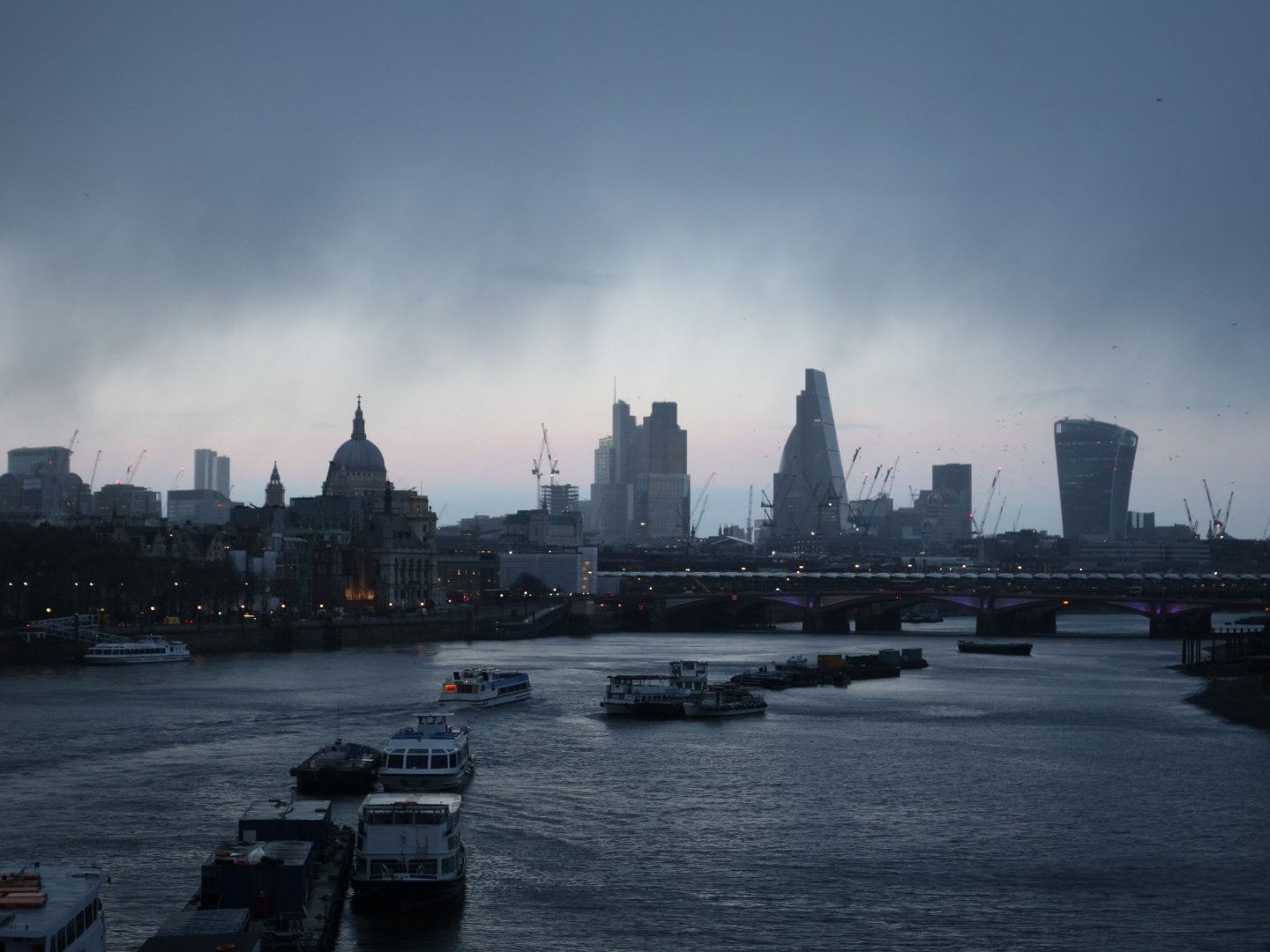
    The City of London


    我这学期给一年级的方法论课当助教。按照惯例,这门课在每学年的最后都要安排整整一星期的田野调研。今天是田野的第三天,学生们四散开去做观察与访谈的时候,我闲坐在Tate Modern附近的小酒吧,顺手写下了一些感想,#不一定对#

    在去年的巴黎恐怖袭击之后,比利时布鲁塞尔郊区的莫伦贝克忽然成了全世界的焦点。最近几天的一系列激烈冲突,进一步把这个地区暴露在各国围观群众的目光里。在目前所见的热烈讨论里,最打动我的是BBC的一个主播去年11月(巴黎恐袭后)追问比利时前首相的问题:为什么是莫伦贝克?你们比利时的内政是否在这里出了问题?ISIS的蔓延,究其本质,是否其实是一种本地化了的事件?

    去年12月,我闲着无聊去比利时转悠了几天,碰到了一个特别能聊的Airbnb房东。她主动跟我聊起莫伦贝克区,说那里之所以变成现在这样,跟比利时人普遍的排外保守、乃至种族主义的态度不无关系。虽说那里以前是郊区工业中心,但是重工业衰落、运河冷清之后,整个区域逐渐变成北非和阿拉伯移民聚居地。

    尽管人口快速增长,公共服务设施却没有跟上。教育、医疗,等等等等,应有尽无。年轻的移民二代们纷纷辍学,继而在就业市场上受歧视,只能通过各种灰色、黑色手段谋生。于是莫伦贝克也就在当地的话语里变成了人人谈之色变的地带,毒品、黑市、犯罪、黑社会…… 如果经济恶化到连这些谋生手段都会受阻,接下来被IS招募也就几乎成了顺理成章的事儿——哪怕他们很多人之前并不信仰伊斯兰教。

    看似全球化了的世界,看似无处不在的ISIS,其实就扎根在这些琐碎平凡的本地细节里。这就是 Doreen Massey 想借助 “a global sense of place” 概念加以说明的东西。在面对这些细节和后果时,请先不要轻易下定论,急急忙忙地去指责某些人、某些族群、或者某种宗教。我们,以及有司,在做这些指责之前,是不是应该反思:比利时政府做错了什么?面对大量移民涌入的郊区(或城市边缘),他们本应该做些什么,能够让事情不会走向如此糟糕的局面?

    这些反思很重要,无论是在政治还是在地理层面。但是本文的目标并没有如此宏伟。我只是想用莫伦贝克作为引子,把这几天带学生在东伦敦做田野时的所见所感给素描出来——毕竟,这里像莫伦贝克一样,也曾被归入 “城市边缘” 的范畴。

    伦敦并不是一个城市,而是一群市镇的集合。事实上,直到今日,伦敦市长 (The Mayor of London) 总共也才只有两任。现任是 Boris Johnson,前任是2000年就职的 Ken Livingstone。在那之前长达十五年的时间里,伦敦是没有“市政府”这一行政级别的。这其中牵扯到的左派前“市政府”和保守党/撒切尔夫人之间的恩恩怨怨,大概也反映了英国中央政府鲜明的集权特征(而不是什么大宪章、分权、自治之类的招牌)。这个话题暂且按下,留待日后再写吧。

    大伦敦地区总共有二十多个市镇,其中只有两个获颁特许状,拥有城市权,一座是威斯敏斯特,另一座是金融城 (The City of London)。 金融城的别名叫 “一平方英里” (The Mile),足可见其袖珍程度。但是这并不能阻碍它的影响力:这里有英格兰银行(和它庞大的地下金库),有伦敦证券交易所,有各种各样的“总部”。虽说东边新建的金丝雀码头分流走了不少巨头,但是这里依然是名副其实的欧洲(乃至世界)金融中心。

    就在这一平方英里的边缘,存在着另外一种截然不同的空间和生活,并常常被贴上 “East End” 的标签。那曾是一个贫穷、疾病、无序的地带,是开膛手杰克盘踞的场所,是混杂着孟加拉商店和索马里难民的社区;那里有着英国巴洛克风格的教堂、乔治时代的联排别墅,但也有整个英国最大的清真寺。初看上去,这里似乎跟布鲁塞尔的莫伦贝克区并无不同:没落的城市边缘,杂居的各色人群、看似停滞了的社会流通渠道。

    但是如果深入到这里的街巷,事情又变得完全不一样。故事实在太多,这里就讲一讲具有代表性的福涅尔街 (Fourneir Street) 吧——它就坐落在 The City of London 曾经的城墙之外;城墙是罗马人的遗存,直到中世纪晚期一直是划分城市内外的界线。

    这条不长的街巷紧挨着 Spitalfields Market,东侧与著名的 Brick Lane 毗邻。我们从这个市场说起:Spitalfields Market 由查理一世下令兴建,后经查理二世扩建(多么悲催的身世)。当时的想法很简单,在 The City of London 的城墙外有很多荒废的空地,不如拿来建成集市,既能方便本地居民,也能趁机收点税。这个市场一直演化和扩展,后来逐渐成为伦敦全城的蔬菜水果批发集散地,直至1991年迁往远郊的Leyton。

    因为这个市场,在17至18世纪遭受严酷迫害的法国胡格诺派新教徒有不少搬到了英格兰,并在这里落脚。邻近的福涅尔街也逐渐成为胡格诺教徒们的保留地。他们不少人来自南特和里昂,掌握着相当先进的纺纱技术,并纷纷在福涅尔街上兴建前店后厂的建筑——确切地说是下店上厂:底层橱窗展示样品,阁楼放置纺纱机。为了满足居住和生产的双重需求,这里的阁楼都建得相当高,甚至可比肩晚近时髦的所谓”loft”。就在这条街的19号,一个叫霍华德的胡格诺教徒后来纺出了维多利亚女王加冕礼服所用的全部丝线。

    经济实力的积累逐渐让他们有能力兴建自己的教堂。1743年,在福涅尔街的东端,一座雄伟的胡格诺派教堂建成启用了。但是在乔治时代晚期,胡格诺人的生意逐渐式微。与此同时,大批犹太人从东欧和俄国移居英格兰,并且像当年的胡格诺教徒一样落脚在福涅尔街上。他们自然很快就展现出了强大的经商能力,并且最终控制了整个街区,包括街区的地景和建筑——在1898年,当年胡格诺教徒兴建的教堂被犹太人改建成了自己的教堂。

    犹太人的崛起并没有让伦敦东区全面建成小康社会。19世纪中晚期,整个东区(包括福涅尔街和砖巷在内)的贫穷和混乱逐渐成为社会的共识,但是当时的政府还没有演化出“福利国家”的特征,各种社会事务基本都由“社会改革家”们 (Social reformers) 操持。他们建成妇女儿童救济中心 (现在是LSE的一座学生宿舍),法律援助中心,移民事务服务中心,志愿服务组织,儿童玩具交换中心等等等等。在做这所有事情的时候,他们没有区分“我们”和“他们”,没有歧视所谓“外来人口”,虽然最终的效果并不如设想的显著,但是却的确真真切切地改善了很多人的生活。

    于是在这个城市边缘,我们能够见到的只有闻名遐迩的开膛手杰克(作为一个事件,以及一种空间的表征/再现),而无恐怖袭击、族群冲突或其他更为恶劣的结局。

    到了20世纪之后,来自巴基斯坦和孟加拉的移民逐渐成为落脚伦敦东区的主体族群。像之前的每一个移民潮流一样,他们也带来了自己的习俗和文化,带来了自己的烤肉店、咖喱店、街头小摊点和露天市场。随着穆斯林成为这个社区的主体,最终,福涅尔街上的犹太教堂在1970年代被改造成了一座清真寺,并且一直延续到现在。

    从新教教堂到犹太教堂,最后到清真寺,这个空间转换不仅具有物质性,而且也可以被视作一种隐喻。这个空间隐喻所再现的是伦敦金融城边缘过去三个世纪的社会过程及其囊括的经济和人口巨变。这样的巨变并不能用简单的诸如 “落脚城市” 一类的概念来归纳,因为后者往往只强调整个社会过程的某一个面向,而忽视了其他很多极为关键的要素和瞬间。

    这个街道所在的市镇政府 (Borough of Tower Hamlets) 并没有把孟加拉人和他们的宗教、习俗、文化视作洪水猛兽,反而尝试着用孟加拉移民和他们故乡之间千丝万缕的联系来推进本地街区的发展。现在走在福涅尔街旁边的砖巷 (Brick Lane) 里,如果你足够细心的话,会发现他们的路牌都已经变成了英文和孟加拉双语书写。不仅如此,雄心勃勃的市镇政府甚至还在努力搞个大新闻,把这整个区域变成 “Bengla Town”。

    在这里,我们已经能够看到在东伦敦和莫伦贝克区存在着相当的区别,而 “落脚城市” 之类的概念则倾向于用某种同一性(比如过度强调移民的社会流动)抹杀这些在地性的差异,因而必须进行批判性地反思。在此,仅止于描述差异似乎还不够,我们还需要思考:到底还有什么样的空间话语 / 路径能够被应用过来,进一步解读和反思像莫伦贝克、福涅尔街这样的城市边缘?

    再进一步追问,在中国这样的地方,当城市持续扩张时,我们是否以及如何可能界定城市的边界与边缘?在任何尝试界定城市边缘的话语里(比如最近流行的 “城中村”、“城乡结合部”),我们该如何探究隐藏其间的政治和政治经济野心?

    如果你感兴趣,并且有空间/时间上的便利的话,欢迎在本月29日(下周二)到旧金山参与我们在AAG上组织的分论坛:(对,这其实是个硬广!)


    1445 Rural-urban continuum area as a “blind field”: Critical reflections on the spatiality of China’s urbanisation

    is scheduled on Tuesday, 3/29/2016, from 12:40 PM – 2:20 PM in Union Square 18, Hilton Hotel, 4th Floor

    Sponsorship(s):
    Asian Geography Specialty Group
    China Specialty Group
    Urban Geography Specialty Group

    Organizer(s):
    Yimin Zhao – London School of Economics
    Hyun Bang Shin – London School of Economics and Political Science

    Chair(s):
    Hyun Bang Shin – London School of Economics and Political Science

    Abstract(s):

    12:40 PM Author(s): *Calvin King-Lam Chung – University College London
    Abstract Title: Urban Sustainability Fix, Rural Environment, and China’s Evolving Rural-Urban Continuum Areas

    1:00 PM Author(s): *Mi Shih – Rutgers University
    Abstract Title: The Multiplicity of Land Expropriation: Villages, Agency and Urbanization in China

    1:20 PM Author(s): *Ye Lin, Visiting Scholar – Department of Anthropology, Harvard University
    Abstract Title: Temporary Life in the “Ruins”

    1:40 PM Author(s): *Ziyan Wang – London School of Economics
    Abstract Title: Contesting Space and Identity: mediated resistance of Chinese migrant workers’ NGO in a rural-urban continuum area.

    2:00 PM Author(s): *Yimin Zhao – London School of Economics
    Abstract Title: Urbanising Greenbelt in Beijing: Spatial tactics, land politics, and urban expansion


  • LSE-PKU Summer School

    Beijing, 8-19 August 2016


    【课程介绍】 LPS-GY201: Speculative Urbanisation in Asia

    转型中的中国和其他亚洲国家城市已经成为社会科学研究的热门领域,相关研究正日益深入,并从早期的现象描述逐渐演进到对内在机理的探索。本课程立足于相关学术讨论,力图把中国和其他亚洲国家的城市变迁放置到投机性的空间生产这一脉络里进行批判性地审视。一方面,课程将深度运用相关文献,从后社会主义城市转型、城市空间生产的政治经济机制、大型赛会的尺度政治、绅士化和遗产保护中的权力关系、进入城市的权利等角度剖析当前亚洲城市日益突出的问题与挑战;另一方面,课程将在大量案例分析的基础上构造若干比较的范畴,在中国与其他亚洲国家、东亚与“西方”等维度上反思比较城市主义的研究视角,强调运用西方理论所需的语境关切,以及借助亚洲经验改造相关理论的可能路径。

    假如你想弄明白……

    • 大量的鬼城和空置楼盘何以出现
    • 房地产投机如何在最近/一线城市愈演愈烈
    • 北京的南锣鼓巷和新加坡的 Little India 的变迁有何异同
    • 东亚四小龙的住房政策如何彼此迥异(植根于各自的政治经济基础)
    • 如何把中国的城市问题与东亚、亚洲和全球议题加以勾连
    • “绅士化”问题的最新理论进展
    • 作为方法的比较城市主义如何加以实践……

    那么本课程将能提供足够多、足够深入的理论和案例信息,并将有气氛热烈的研讨班 (seminar; 80 min/day) 作为增进讨论的有效平台。

    详情请戳:

    http://www.lse.ac.uk/study/summerSchools/LSEPKUProgramme/courses/gy201.aspx


    About the summer school:

    LSE and Peking University have collaboratively run the LSE-PKU Summer School in Beijing every summer since 2004. The twelfth SE-PKU Summer School will run from 8-19 August 2016. The two-week English-language international programme offers university-level courses all with a focus on China and Asia in subjects including economics, management, international relations, geography, the media, big data and NGOs.

    The LSE-PKU Summer School provides a unique opportunity to learn about China from within China, but with a truly international perspective. The programme is taught in English by outstanding faculty from LSE and PKU – two of the world’s leading institutions for teaching and research.

    In 2015, the LSE-PKU Summer School was attended by 283 participants from more than 50 countries across Africa, Europe, Asia and the Americas, one third of whom were graduate professionals from different industries, governments and NGOs. This enriches class discussions, social events and networking opportunities.

    Each course totals 48 contact hours (usually 36 hours of lectures and 12 hours of classes), and is formally assessed to allow the award of an official transcript. Whilst neither LSE nor PKU formally award credit for the programme, many previous participants have been able to receive credit from their home institutions – we are very happy to provide any information to assist with this.


    Course information:

    The course “Speculative Urbanisation in Asia” (LPS-GY201) explores the contemporary dynamics of urbanisation in Asia, with special emphasis on cities in China and other East and Southeast Asian economies, which share the experiences of rapid urban development with strong state intervention in the context of condensed industrialisation. The course will benefit from the geographical advantage of taking place in Beijing and make use of a number of China case studies to examine the differences as well as similarities of urban development between Chinese and other Asian cities.

    Applying interdisciplinary and comparative perspectives, the course encourages students to develop critical knowledge and comparative understanding of how urban space is transformed in different social, economic and political settings, and what socio-spatial implications are made in a differentiated way upon local populations.

    Throughout the course, we ask whether the concepts and theories born out of the (post-)industrial Western urban experiences can be applicable to the understanding of urban Asia. We also ask what are the challenges that cities in East and Southeast Asia face, given its current development trajectory.

    We do this by examining a set of carefully selected themes that address (1) the integration of Asian cities with the global economy, (2) the distinctive characteristics of Asia’s urban development,(3) the place-specificities of state intervention in forming urban growth strategies, and (4) socio-political implications of urbanisation processes in the region.


    About the Instructor:

    Dr Hyun Bang Shin is an Associate Professor of Geography and Urban Studies in the Department of Geography and Environment at the London School of Economics and Political Science. Dr Shin is a specialist in urban Asia. His research includes the critical analysis of the political economic dynamics of urban (re-)development and covers Asian urbanisation, urban politics, displacement and gentrification, the right to the city, and mega-events as urban spectacles.

    New publications:

    (2015) (eds.) Global Gentrifications: Uneven Development and Displacement. Bristol: Policy Press

    (2016) Planetary Gentrification. Cambridge: Policy Press

    (2016) Special issue: Locating Gentrification in the Global East. Urban Studies 53(3)


  • RGS-IBG Annual International Conference, London, 30 August – 2 September 2016

    Call for Papers
    Narrating Displacements – A Radical Way to Rethink Urban Theories and Politics

    Organisers:

    Hyun Bang Shin (Geography, London School of Economics) h.b.shin@lse.ac.uk

    Mara Nogueira (Geography, London School of Economics) m.nogueira-teixeira@lse.ac.uk

    Yimin Zhao (Geography, London School of Economics) y.zhao25@lse.ac.uk


    Nowadays, we have been witnessing the rise of urban expansion, gentrification, mega-events and many other political economic events; all of them have direct impacts on the daily life of local residents through large- or small-scale displacements. Displacement is a term that has been widely used for critical urban theories in analysing contemporary urban change, especially in the Anglo-Saxon world. Yet when people use this word in the literature, relatively few attentions are paid to mechanisms through which place-based understandings of displacement are enabling/bounding the historical-geographical conjuncture of domination and resistance.

    Discourses of displacement are diverse geographically; they are also narrated and deployed by different subjects from distinct perspectives in displacement processes. Expressions like “chaiqian” (demolition and relocation), “qianyi” (relocation), “qiangpo qianyi” (forced relocation) are used in China to express actions through which the state institutions and businesses operate. In South Korea, “cheolgeo” (demolition), “gangje cheolgeo” (forced demolition) or “yiju” (relocation) are more frequently utilised by those subject to displacement. Elsewhere in Latin America, for example in Brazil, “despejo” (eviction) “desalojamento forçado” (forced eviction) and “expulsão” (expulsion) are common concepts deployed by those suffering displacement threats and their allies, whereas the actors promoting displacement prefer to deploy milder terms such as “desocupação” (evacuation) or “realocação” (reallocation).

    The use of these particular expressions shifts the focus towards the final act of displacement; even though in reality people would experience (the feeling of) displacement long before actual demolition, eviction or relocation. Moreover, discussions about belonging and the sense of place show how displacement may occur even in the absence of such events. In this regard, abrupt changes to space might cause people to feel “out of place” even though they remain in the same location. To narrate the experience of displacement focusing only on the final acts has serious negative implications on formulating effective strategies that allow pre-emptive earlier contestations to resist and counteract displacement pressure. Furthermore, how displacement is actually narrated in a given local context is not trivial, for conceptualising displacement is itself political.

    This session invites papers to reflect on narratives and discourses mobilised around displacement in a diverse range of social, political, economic and cultural settings by attending specifically to the tensions emerging from conceptualisation of displacement by different subjects in daily practices. The aim is to collaboratively reveal the role of displacement discourse in constructing the historical-geographical conjuncture of domination/resistance, and to uncover power relations/ mechanisms and state effects produced within this conjuncture. Suggestive topics include:

    • Place-based understanding (especially outside the Western context) of displacement and its socio-spatial effects;
    • Conceptualising displacement by different subjects;
    • The role of space in enabling or bounding people’s conceptualisation of displacement, or in affecting their reflections on the gaps between different conceptualisations;
    • The state manoeuver and tactics in promoting displacement with legitimised (sometimes hegemonic) ideology;
    • The effects of different narratives in reshaping understandings of displacement and in opening up possibilities of resistances

    Deadline: 15 February 2016

    To be considered, please submit an abstract of 250 words (maximum) to all three email addresses above.


  • Call for Papers: Annual Conference of the Association of American Geographers (San Francisco, CA, March 29 – April 2, 2016)

    Session Title: Rural-urban continuum area as a “blind field” – Critical reflections on the spatiality of China’s urbanisation

    Session Organisers: Yimin Zhao and Dr Hyun Bang Shin (London School of Economics)

    This session aims to contribute to a lasting discussion on the spatiality of China’s urbanisation. In the last two decades, literature in urban studies has been witnessing considerable research on China’s urban questions such as “villages in the city” / “urban villages,” suburbanisation in the urban process, peri-urbanisation beyond metropolitan centres, and emerging migrants’ settlements in the urban periphery. When significant socio-economic conditions and transitions in China’s urbanisation process have been uncovered (such as the rise of dual urban-rural land market and the changing demographic characters), the spatiality of this process is still to some extent blurred. One reason of this blurriness is a hidden assumption of the urban as a pre-given and self-evident bounded entity. Yet the dynamics of urbanisation immediately makes this assumption problematic.

    If we take a relational view of space and the “urban”, then more nuanced explorations are required to identify and uncover the temporal-spatial and political-economic mechanisms through which the “urban” becomes a process. It is here that the “rural-urban continuum area” (as the frontier area subject to be urbanised) should be put at the focus of investigations. Following Lefebvre’s (2003) conceptualisation, the rural-urban continuum area can be taken as a “blind field” between urban and rural layers/ periods/ fields. Though Smith (2003) claims that the “blind field” is more an (ideological) metaphor than an empirical observation, we would contend that the materialisation of this term can radically open a new approach through which the problematic representations of the urban reality can be questioned and the underlying mechanisms of the urban process can be revealed. And it is only in this way that the complexity of China’s urbanisation can be discussed to its full extent.

    We want to take this session as an invitation to rethink the spatiality of China’s urban process through empirical research of the rural-urban continuum area which is still by and large a “blind field.” We invite papers investigating dynamic spatiality and temporality of the rural-urban continuum area from a relational and dialectical perspective. We are also interested in discussions of political-economic mechanisms underlying such dynamics. For instance, when we explore the power of capital and the establishment of the state-capital coalition in China’s urban process, a further (spatial) question can be raised with regard to how the stigmatisation of the “rural-urban continuum area” becomes a condition to activate the coalition in reality. If we focus on the state’s endeavours in (re-) territorialisation of the rural-urban continuum area, then more attentions are needed to depict the historical-geographical conjuncture in which transformed spaces are articulated with both heterogeneous cultural / historical elements and changing power relationship. These examples are by no means the boundary of discussions. All contributions related to the changing spatiality and political economy of China’s rural-urban continuum area are welcome to collaboratively uncover this “blind field.”

    For those who would like to participate, please submit abstracts (or a brief statement of interests) of no more than 250 words by email to Yimin Zhao (y.zhao25@lse.ac.uk) by Monday 19th October 2015. Successful submissions will be contacted by 23rd October 2015 and will be expected to register and submit their abstracts online at the AAG website by October 29th 2015.

    (Note: this session will have a discussant, TBC)

    References

    Lefebvre, H. 2003. The urban revolution. University of Minnesota Press.
    Smith, N. 2003. Foreword. The Urban Revolution, by Henri Lefebvre. University of Minnesota Press. vii-xxiii.